
Sonia Quintero
Social Science and Social Work, UEL
UBEL Pathway: Gender and Sexuality
Supervisor: Prof Giorgia Dona
Contact details/Social Media/Website:
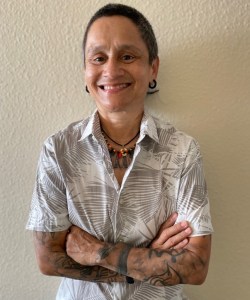
About Me
I am a queer Colombian–British poet. I have lived in London for 15 years and have published several poetry books, both in English and Spanish. In my poetry I explore mental health and social issues, and when writing in English I reflect on topics such as migration, refugees, identity and belonging. I did my undergraduate Psychosocial studies, as well as a MA in Conflict, Displacement and Human Security at University of East London (UEL) where I am an active member of The Centre for Migration, Refugees and Belonging (CMRB). I have become an active member of the community and have led several projects that combine my passion for poetry and LGBTQ+ rights.
Six years ago, I started Newham Poetry Group, a grassroot initiative that facilitates access to creative writing for people who speak English as their second or third language as well as engaging with marginalised communities through artistic activities such as open mics, spoken words or even publishing their own books.
I also co-founded Queer Newham, a local initiative that brings visibility to LGBTQ+ issues in my area. We work closely with the LB Newham, community groups and neighbours to tackle discrimination, hate crime and other issues that impact us.
@Sonesquin (Twitter)
My Research
According to UNHCR (2020) there are more than 80 million people who have been forced to leave their home countries, from this number, there is an unrepresented community, the LGBTQ+ population. They face lack of understanding, rejection and persecution by families and state, but more important, often experience internal conflict due to internalised heteronormative discourses and values. The proposed project is based in the findings of my MA dissertation when working with LGBTQ refugees in London. The findings brought more complex questions about the impact of heteronormativity in the formation of identity, the lack of sense of belonging as results, in both LGBTQ+ and non-LGBTQ+ refugees.
By exploring the experience of heteronormativity in LGBTQ+ and non-LGBTQ refugees’ life, the study will bring the issue of heteronormativity to the forefront of refugee well-being, as well as make the issue of heteronormativity part of current debates and recognise the crucial and central role it plays in the welfare of LGBTQ+ refugees. The research will contribute to develop approaches of addressing the inner conflict, in addition to address some of the factors that perpetuate a problematic approach, such as the persisting invisibilisation of LGBTQ+ identities and internalised homophobia in both refugees’ nations of origin and host countries. By documenting the experience of heteronormativity in LGBTQ+ and non-LGBTQ refugees, this analysis will highlight the difficulties encountered when this community is treated as homogenous, and the need for a wider approach in refugee studies.
An examination of the literature shows a lack of representation of the LGBTQ+ community in refugee’s studies, an insufficiency in approaching the topic of heteronormative and its implication in understanding refugees’ experiences. Studies about LGBTQ+ refugees are few and normally centred in legislation and policies (Wieland, R. Alessi, E. J. 2021. Bachmann, 2016. Taylor, 2015. Sirriyeh, 2010. Fadlalla, 2011. Jordan, 2011. Ahmadi, 2001).
Impact of My Research
The short-term impacts of the proposed study will be on LGBTQ+ refugees’ lives and other marginalised groups oppressed by heteronormativity. It will bring this issue to the forefront of debates about LGBTQ+ refugees’ well-being and welfare in the UK. Refugee studies are, mostly, based on a binary understanding of concepts such as gender, sexuality, race, nationality, and identity.
The research will have a medium-term impact in refugee studies literature, LGBTQ+ refugees’ lives, wider society, and the charity sector. This will be achieved by contributing to the development of effective approaches to addressing the factors that perpetuate the persisting invisibilisation of LGBTQ+ identities. The research will also inform strategies for addressing the difficulties encountered when this community is treated as homogenous or a mere subsection of the general refugee population, as well as the effects of the internalised homophobia in both the refugees’ countries of origin and host nations.
You must be logged in to post a comment.