Sebastian Wolfrum
Department, Institution: Anthropology, UCL
UBEL Pathway: Anthropology
Supervisor: Dr. Ludovic Coupaye, Dr. Rafael Chiaravalloti
Contact details: Sebastian.wolfrum.22@ucl.ac.uk
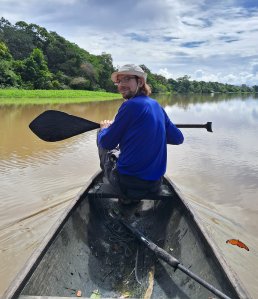
About Me
My initial training was in Social Work (BA) at the University of Applied Science, Nuremberg, Germany. After working several years full time in that field, I returned to university and completed studies in Environmental Geography (BSc) at the University of Stirling, followed by a MSc in Anthropology, Environment and Development at UCL. Throughout these degrees I have focused on the interaction between human societies and the environment they live in. To that end, I employ a post-humanist and phenomenological approach for understanding the entanglements of humans and non-humans in webs of interaction. Outside of academia, I am a member of the Alpine Club and like to explore remote mountain areas around the world.
My Research
My research explores community-based management (CBM) schemes for Arapaima gigas, a large predatory freshwater fish in the Amazon. Special focus will be placed on the impact of the actualisation of the material culture of the fishing-community within the context of the CBM-schemes. Existing research has so far focused on understanding CBM-schemes through the lens of social-ecological system (SES) theory and ecological and economic monitoring. Parallel but unconnected research has highlighted that local ontological considerations about technical objects and the fish itself can play an important role in motivating local populations in supporting CBM-schemes. How these aspects connect and relate to economic and social-ecological considerations is unknown. In essence, we can ask: How is the social-ecological system actualised, mediated, and shaped by technology? With my research I aim to develop an integration of material culture and SES-theories, addressing a gap in anthropological theory, study and understanding. Fieldwork will be carried out in communities with and without CBM-schemes in the Jurua-region of the Amazon. The study will follow a mixed-method approach, collecting data through interviews, focus-groups, and surveys.
Impact of My Research
My research will have tangible relevance for addressing the pressing challenge of a better integration of habitat and species protection with economic development in areas of conservation concern in the Global South. The research directly addresses challenges posed by the Kunming-Montreal Global Biodiversity Framework, 2022, with its aim, to set aside 30% of all land for area-based protection by 2030 (30×30). This framework includes references to equitable rights for local populations. Important work towards such equitable rights can be done by expanding our knowledge and understanding about how local cosmologies (here actualised through technicity) can be incorporated into more equitable policies concerning nature-conservation in areas where groups of people practise subsistence fishing. As 50 out of the world’s 51 million fishers operate in small-scale fisheries the understanding of otherwise largely elusive win-win scenarios for both, economic development, and environmental protection, as is reported from Arapaima fisheries, is of great relevance. In advancing this understanding, the research will also directly relate to Sustainable Development Goals (1) no poverty, (2) zero hunger, (12) responsible production and consumption and (14) life below water.