
Chris Lehmann
Department, Institution: School of Social Sciences, Birkbeck
UBEL Pathway: Gender and Sexuality
Supervisor: Dr Sean Brady and Dr Silvia Posocco
Contact details: clehma01@student.bbk.ac.uk
About Me
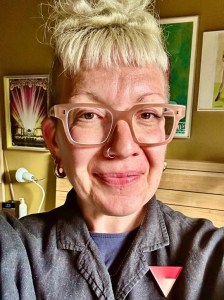
I am currently a PhD Candidate in Gender and Sexuality at Birkbeck, University of London. One of my main motivations as a researcher is to realise praxis; to bring learning into policy and practice by increasing opportunities for and sharing the outcomes of research. My interests are driven by a deep commitment to human rights, equity and social justice.
I grew up in Massachusetts, spent time in California and moved to London in 2003, where I am now settled with my wife. My career has involved a broad range of work, from bartending and managing adventure playgrounds to supporting young people’s participation and commissioning services for adult social care. I left university in the United States at the age of 19 because of barriers that restricted my ability to study queer theory. I feel privileged to return to this far-reaching and often contentious area of interest with augmented life experience, and at a time of significant importance for our community.
I restarted my education in my 40s and now hold an MSC in Social and Political Theory through Birkbeck. I am proudly queer and nonbinary, and hope that the work I do through academics, my career and volunteering can support people in the LGBTQ+ community and beyond to thrive in their chosen identities.
I am inspired by a lifelong relationship with music, and feel fortunate to be able to play violin and piano. I enjoy spending spare time at my allotment with my partner, enjoying art exhibitions and dancing to all different genres of music.
My Research
Extensive primary and secondary research carried out for my MSc dissertation revealed a lack of recognition of the needs of ageing and elder LGBTQ+ (queer) people in England, and a dearth of services and legal frameworks to adequately support them. In fact, interviews with a diverse cross-section of the queer community identified significant concerns about equitable access to services based on their lived experiences. Their concerns are substantiated by a lack of regard for queer people in health, social care and housing, exhibited through a deficiency of policy, training and bespoke services to support these communities effectively. A strong theme of the ‘chosen family’ also emerged from my Masters’ primary research, which is a protective factor and a unique component of queer communities that could be used as an opportunity to disrupt societal views, redesign services and influence legal frameworks.
I propose to delve deeply into our current interpretation of the ‘family’ with interlocutors that explore alternative approaches to kinship, with clarity and reflexivity about the queer lens through which I will approach my research and the interpretation of its results. I will use robust research methods, with a focus on oral histories, to gather evidence about how queer kinship groups are formed and recognised across time, place, and populations. I will carry out extensive, ethical primary research through interviews, focus groups, questionnaires and visits to health and care settings that support queer people and their carers. I will counter societal reference points for favoured, biopolitical familial relations in England, and seek to understand if disruption to societal expectations will allow new possibilities for queer kinship futures to emerge.
Impact of My Research
My research will combine an analysis of demographic data about queer populations (recognising that this has limitations and biases) alongside a systematic review of social care policy and implications for LGBTQ+ communities in England. The project will offer methodological innovation by combining quantitative analysis of existing datasets from a queer analytical perspective, alongside a qualitative approach focussed on oral histories, case studies of individuals’ lived experiences and fieldwork across rural and urban locations.
The timeliness of this research is critical. Queer people who were active in their communities in the 1960s – 1990s are beginning to reach middle and older age. Many have to draw on care and support for the first time in their lives and make important financial or accommodation decisions for their future. Through my career in adult social care, my role as a volunteer with ‘Opening Doors’ and as a current trustee for the queer mental health charity elop, I continue to observe significant concerns for this diverse community, particularly in the navigation of societal expectations and legal frameworks of kinship.
This proposal is situated at a particularly important time when government seeks to make strategic changes to health, social care and housing. There is an urgent need to capture primary research about ageing and elder queer folk that will influence these emerging systems and practices in England.
You must be logged in to post a comment.